Understanding Commercial Floor-Care Equipment: What Each Machine Is Designed to Do
The short answer: A low-speed floor buffer scrubs and strips. A high-speed burnisher polishes an already clean, finished floor to a high gloss. An automatic floor scrubber lays down solution, scrubs and vacuums up the dirty water in one pass. An orbital machine oscillates instead of rotating and reaches edges and corners. Wet/dry and backpack vacuums handle recovery and dry soil removal.
Walk into a custodial equipment room and you may find several machines that look, to a new hire, as if they do roughly the same thing. They do not. Using equipment professionally means knowing what each machine is built to accomplish, what surface it is going on, which pad or brush belongs with the procedure, and where its limits are. In floor care, the wrong machine or accessory can turn a routine job into an expensive flooring problem.
Floor buffer vs burnisher: what is the difference?
This is the comparison people ask about most, so it comes first. Both spin a pad on the floor. Speed and purpose are what separate them.
- Floor buffer (also called a low-speed rotary, swing machine or floor machine): according to Tennant, most run at about 175 RPM, with some dual-speed models reaching around 400 RPM. Used for scrubbing and stripping, and light polishing at the higher speed.
- Burnisher: typically 1,500 to 2,500 RPM. Used to bring a clean, compatible finished floor up to a high-gloss “wet look”.
A burnisher is not simply a faster buffer. Its pads, handling and relationship with the floor finish are different, and it is not the machine for stripping or for removing soil.
Low-speed rotary floor machines (floor buffers)
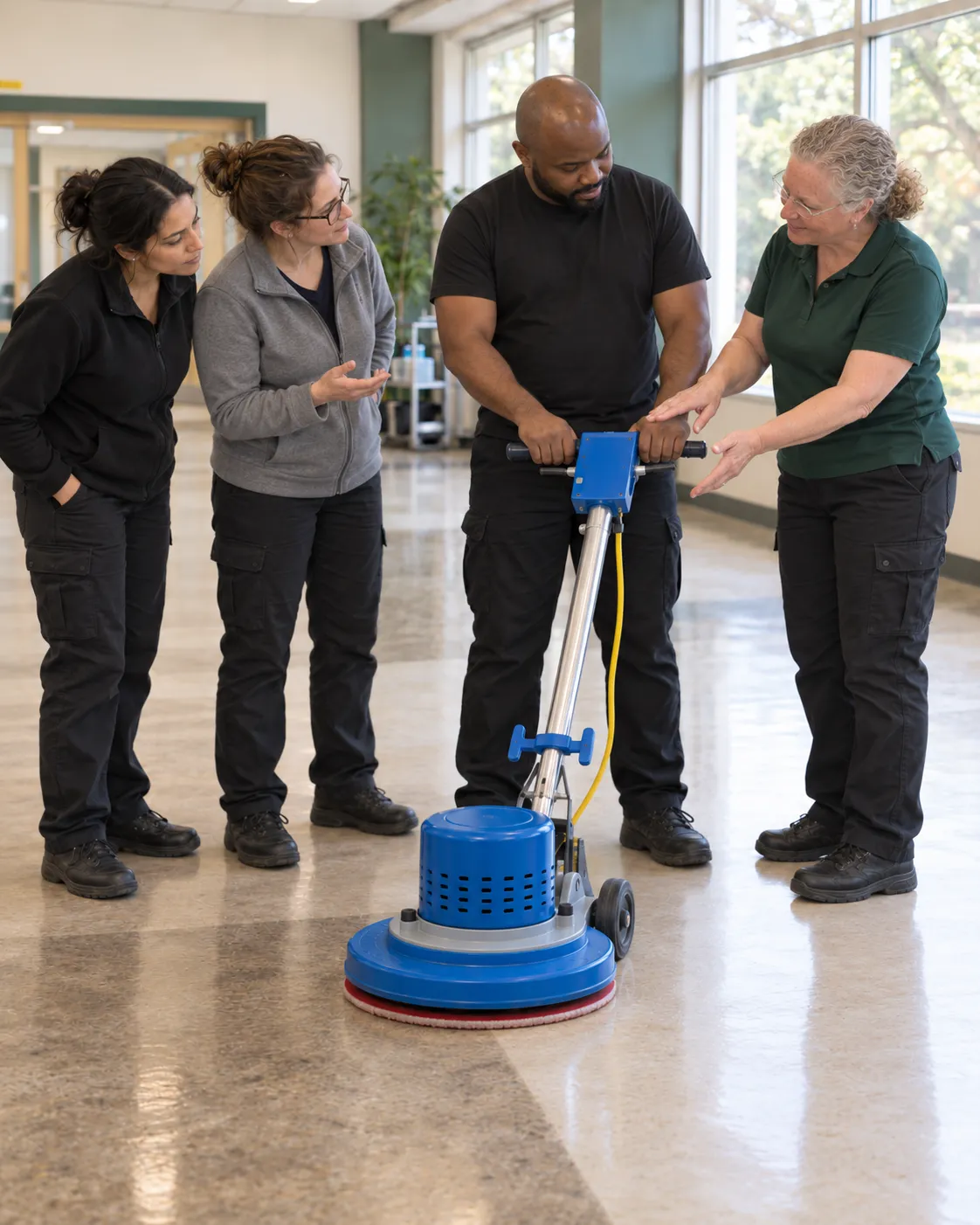
The rotary floor machine is the most recognizable piece of floor-care equipment. A pad or brush rotates against the floor and the operator steers by raising and lowering the handle, balancing the machine as it swings from side to side. That balance takes practice.
What the machine does depends on how it is set up. The pad or brush, the chemical, the flooring and the technique decide whether you are scrubbing, stripping or polishing. Pad selection is part of the procedure, not an afterthought.
High-speed burnishers
Burnishing maintains or restores gloss on a compatible finished hard floor. The floor must be properly cleaned first, because a burnisher will grind remaining soil into the finish. It is an appearance tool, and it cannot repair the kinds of problems described in why floor finish fails.
In Servitech courses, high-speed burnishers are covered through video instruction, not hands-on operation.
Automatic floor scrubbers (auto scrubbers)
An automatic floor scrubber, or auto scrubber, combines three steps in one machine: it puts cleaning solution on the floor, agitates it with brushes or pads, and recovers the dirty solution through a rear squeegee and vacuum into a separate tank. Walk-behind and ride-on models work the same way.
The recovery step is what makes the difference. A floor is not clean because soil has been loosened. The soil has to leave the floor. Auto scrubbers improve productivity over large open areas, but the operator still needs to understand the floor, the chemical and dilution, solution flow, pad or brush choice, squeegee condition and daily maintenance. Poor setup gives poor results from excellent equipment.
Rectangular orbital floor machines
Orbital machines use a rapid oscillating motion instead of the circular action of a rotary machine. The rectangular head gets closer to edges and into corners. Depending on the model, floor and pad, they are used for scrubbing and for some surface preparation or finish removal work. As always, the accessory and the procedure have to match the surface.
In Servitech courses, rectangular orbital machines are demonstrated through video instruction.
Wet/dry vacuums
A wet/dry vacuum looks simple next to a floor machine, but it does an important job: it recovers liquid and slurry that a dry vacuum cannot handle. During stripping and scrubbing, that means the dirty solution is removed before it dries back onto the floor.
Being able to pick up liquid does not make every substance safe to vacuum. Hazardous materials, biohazards and unknown chemicals need their own procedures and equipment.
Backpack vacuums
A backpack vacuum puts the unit on the operator, who moves the hose and wand through the space instead of dragging a canister around furniture. They suit offices, classrooms, stairways and anywhere with obstacles. Fit matters: the harness has to be adjusted to the operator, and cord or battery management and working pattern all affect both efficiency and strain.
Mops still require skill
Mops get less attention because they look simple, but the same principles apply. The system has to suit the task, solution has to be controlled, tools have to be kept clean, and cross-contamination has to be managed. A $10,000 floor machine can be used incorrectly. So can a mop.
Pads and brushes are part of the equipment
Pads and brushes are how the machine’s mechanical action reaches the floor. They differ in aggressiveness and are rated for particular machines and speeds. This matters most on high-speed equipment. A pad that physically fits is not automatically right for that machine, that speed or that floor. Using the wrong one is on our list of common commercial cleaning mistakes.
How to choose the right floor machine
- Stripping old finish: low-speed floor machine with a stripping pad, plus a wet/dry vacuum for recovery.
- Daily cleaning of large open floors: automatic floor scrubber.
- Restoring gloss on a clean finished floor: high-speed burnisher.
- Edges, corners and some prep work: rectangular orbital machine.
- Small rooms and tight areas: mop system or a compact scrubber.
- Offices, classrooms and stairs: backpack vacuum.
Bigger or faster is not automatically better. Equipment selection is about matching capability to conditions.
The most important machine in the room is the operator
Equipment improves productivity and consistency, but it does not decide what the surface is, what the task requires, which product and pad are appropriate, or what result to expect. Those decisions belong to the person doing the work, and to the supervisor who trains and checks it. That is why Servitech teaches equipment as one part of a system: surface, product, equipment and procedure. When the four work together, cleaning becomes repeatable. When they do not, buying a better machine rarely fixes the underlying problem.
Related training: BSW 2: Hard Floor Care covers floor-care techniques, equipment, chemistry and products with hands-on instruction, delivered on-site across British Columbia. Request training for your team.
Frequently asked questions
What is the difference between a floor buffer and a burnisher?
A floor buffer is a low-speed machine, usually about 175 RPM, used for scrubbing and stripping. A burnisher runs at roughly 1,500 to 2,500 RPM and is used to polish a clean, finished floor to a high gloss.
What does an automatic floor scrubber do?
An auto scrubber applies cleaning solution, scrubs the floor with brushes or pads, and recovers the dirty solution with a squeegee and vacuum as it moves forward.
Is an orbital floor machine the same as a rotary floor machine?
No. An orbital machine oscillates rapidly instead of rotating, and its rectangular head reaches edges and corners. Applications vary by model, pad and surface.
Can you strip a floor with a burnisher?
No. Stripping is done with a low-speed floor machine and a stripping pad. A burnisher is designed for polishing a clean finished floor.
Can the same floor pad be used for every job?
No. Pads vary in aggressiveness and intended use. Match the pad to the machine speed, the flooring and the procedure.
Do you need training to operate commercial floor equipment?
Yes. Running the machine is only part of the task. Operators also need to understand the floor, the accessories, the chemistry, safe operation and the result they are aiming for.