Choosing the Right Cleaning Product for the Surface: Why Chemistry Matters
The short answer: Choose a cleaning product by asking three questions in order: what is the surface, what is the soil, and what chemistry and procedure will separate the two without damaging the surface or the worker. Then use the product exactly as the label directs, at the stated dilution and contact time.
One of the most useful habits a cleaning professional can build is to stop asking “what is the strongest cleaner we have?” and start asking “what am I cleaning, and what am I trying to remove?”
A commercial building holds dozens of materials: resilient flooring, finished floors, ceramic tile, grout, glass, stainless steel, painted walls, washroom fixtures, carpet and stone. A product that performs well on one can be useless, or damaging, on another. That is why professional cleaning needs some chemistry. Not a degree, only enough to understand why you are using the product in your hand.
Step 1: Identify the surface
Before opening a container, know what you are cleaning. It sounds obvious and it is the step most often skipped. A surface may carry a coating or finish that is not visible. Two floors that look alike can be different materials on completely different maintenance systems. Manufacturers also restrict which chemicals, pads and methods are allowed.
If you cannot positively identify the surface, that is a reason to stop and find out. It is not a reason to try a stronger cleaner.
Step 2: Identify the soil
Dust, oils, food soil, mineral scale, soap residue and biological contamination all behave differently. Cleaning is the act of separating unwanted material from a surface and removing it, so the product has to suit the soil as well as the surface. One all-purpose cleaner will not solve every problem.
What does pH have to do with cleaning?
The pH scale describes whether a water-based solution is acidic, neutral or alkaline. As a rule of thumb, alkaline cleaners are formulated for greasy and organic soils, acidic cleaners for mineral deposits such as scale and rust, and neutral cleaners for routine cleaning where the surface or its finish must be protected. A neutral floor cleaner, for example, is the usual choice for daily mopping of a finished floor.
pH is only part of the picture. A cleaning chemical is a formulation, and surfactants, solvents and chelating agents all affect how it performs. Choose by the label, the technical sheet and the Safety Data Sheet, not by how strong someone says it is.
Does more chemical clean better?
No. If the label calls for a set dilution, doubling the concentrate does not double the cleaning. It moves the product outside the range it was designed for. The usual results are sticky residue that attracts soil, extra rinsing, wasted product and more chemical exposure for the worker. The Canadian Centre for Occupational Health and Safety (CCOHS) advises following the manufacturer’s instructions when diluting, and adding concentrate to water, not water to concentrate.
Measured dilution, ideally through a dispensing system, also makes the result repeatable. If five people mix the same product five different ways, there is no real procedure.
Is hot water always better?
Not automatically. Water temperature changes how a chemical behaves and how some soils and surfaces respond. Some products specify a temperature range, and some surfaces have limits. The correct temperature is the one the product and the surface call for.
Cleaning and disinfecting are not the same thing
Cleaning physically removes soil. Disinfecting uses an approved disinfectant, according to its directions, to inactivate specific microorganisms. Soil can shield germs, so a dirty surface usually has to be cleaned before it can be disinfected. The CDC tells users to clean visibly dirty surfaces first and to keep the surface wet for the full contact time.
Contact time, also called dwell time, is how long the product must stay wet on the surface to work. Spraying a disinfectant and wiping it straight off rarely does what the person holding the cloth assumes.
Never mix cleaning chemicals
If one cleaner works and another works, combining them does not make something twice as good. It can make something dangerous. Bleach mixed with ammonia or with acidic cleaners can release toxic gases. Both the CDC and CCOHS warn against mixing cleaning or disinfecting products.
A worker who has been told “never mix those two bottles” has memorized a rule. A worker who understands that cleaning chemicals react with each other knows why unapproved mixing of any kind is a bad idea.
How to use the Safety Data Sheet
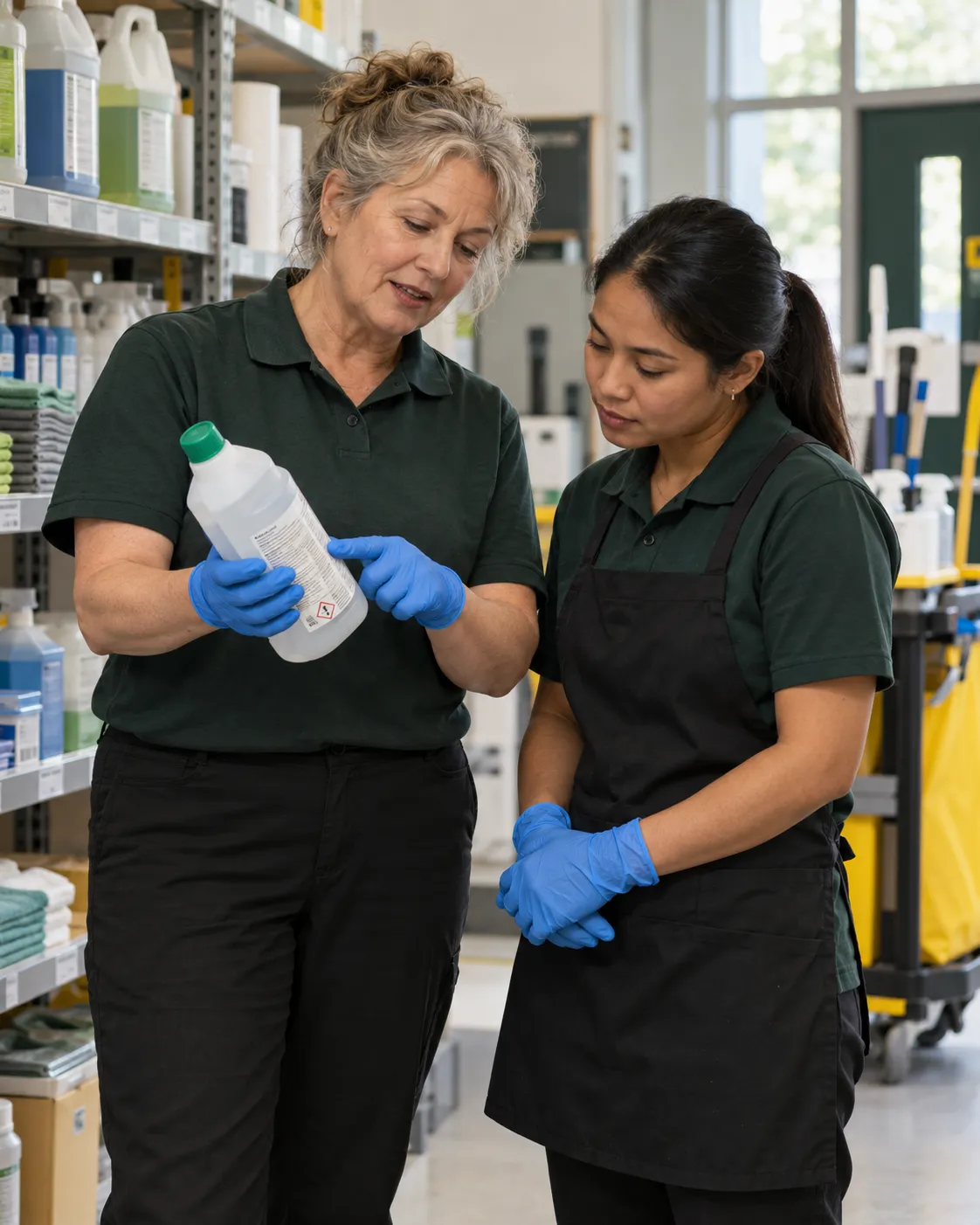
In Canada, hazardous workplace products fall under WHMIS, which relies on labels, Safety Data Sheets (SDS) and worker education. The SDS tells you the hazards, the protective equipment, safe handling and storage, and what to do in an emergency. Knowing where the binder is kept is useful. Knowing how to read the sheet before you open the product is better.
A quick checklist for choosing a cleaning product
- Identify the surface and check the manufacturer’s care instructions.
- Identify the soil you are trying to remove.
- Pick a product formulated for that soil and safe for that surface.
- Read the label and the SDS before use.
- Dilute exactly as directed, using measured dispensing.
- Allow the stated dwell or contact time.
- Use the right pad, brush or cloth, and remove the dirty solution.
- Never mix products.
The product is only one part of the system
Even the correct chemical gives a poor result if the procedure is wrong: the wrong dilution, too little dwell time, the wrong pad, or dirty solution spread back over the floor. Servitech teaches cleaning as a connected system of surface, product, equipment and procedure. Get one wrong and you see it in problems such as the ones in why floor finish fails and our list of common commercial cleaning mistakes.
Related training: BSW 1: Basic Commercial Cleaning covers the chemistry of cleaning, the pH scale, chemical safety, chemical measuring and WHMIS/GHS. It is delivered on-site for organizations across British Columbia and leads to the BSW Level 1 certificate. Request training for your team.
Frequently asked questions
Can one cleaner be used on every surface?
Usually not. Commercial facilities contain different surfaces, coatings and soils, each with its own care requirements. Check the product label and the surface manufacturer’s directions.
Is a stronger cleaning chemical better?
Not necessarily. The product should match the soil, the surface and the procedure. Using a higher concentration than the label specifies tends to leave residue and adds risk without improving the result.
What is a neutral cleaner used for?
A neutral cleaner has a pH close to 7 and is used for routine cleaning where the surface or its finish needs protecting, such as daily mopping of finished floors.
What does dwell time or contact time mean?
It is how long a product must stay wet on a surface to do its job. It matters most for disinfectants. Follow the time on the label.
Do you need to clean before disinfecting?
Usually yes. Soil can stop a disinfectant from reaching the surface, so visibly dirty surfaces should be cleaned first, then disinfected for the full contact time.
Why is chemical training important for cleaning staff?
Workers need to know where a product can be used, how to dilute it, what hazards it presents and how it fits the overall procedure. That knowledge protects the worker, the surface and the result.