Common Commercial Cleaning Mistakes and Why They Matter
The short answer: Most commercial cleaning mistakes come from the same root: using the wrong combination of surface, product, equipment or procedure. Over-using chemical, skipping dwell time, mixing products, cleaning with dirty tools and picking the wrong pad or machine are the most common, and all of them are training problems more than effort problems.
Cleaning problems are often blamed on the person doing the work. That is not always fair. A custodian can be hardworking and careful and still get poor results if nobody has explained the chemistry, the equipment, the surfaces or the reasons behind the procedure. In professional cleaning, effort and knowledge are not the same thing. Someone can scrub harder, use more chemical and make the problem worse.
Here are twelve mistakes we see across janitorial and custodial work, and why each one matters.
1. Using more chemical because the surface looks dirty
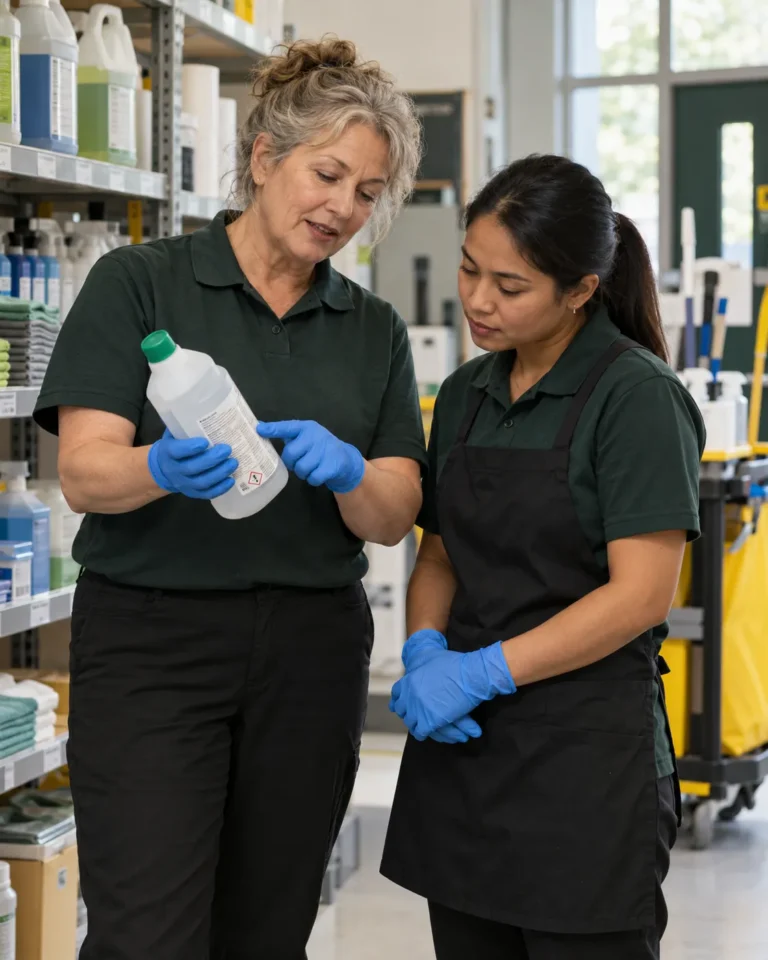
If some cleaner works, more should work better. It does not. Products are formulated for a set concentration, and going past it leaves residue, wastes product, increases exposure and makes rinsing harder. The Canadian Centre for Occupational Health and Safety (CCOHS) advises following the manufacturer’s dilution instructions. If a floor still looks dirty, ask what the soil is, whether this is the right product, whether the dilution is correct and whether the dirty solution is actually being removed.
2. Assuming hot water always cleans better
Temperature changes how chemicals, soils and surfaces behave. The right water temperature is the one the product and the surface call for.
3. Using one chemical everywhere
Glass, finished flooring, stone, stainless steel and washroom fixtures do not share one ideal cleaner. Using whatever is already on the cart leads to poor results or damage. Recognizing the surface is a professional skill, and it comes first. See our guide to choosing the right cleaning product for the surface.
4. Believing the strongest product is the best product
Cleaning is not a contest to find the harshest chemistry. The aim is to remove the soil while protecting the worker and the surface. A more aggressive product than the job needs adds risk and often adds work.
5. Eyeballing dilution
One person’s “splash” is another person’s “glug”. If five employees mix the same product five ways, the facility has no standard procedure. Measured dispensing turns guesswork into a repeatable process.
6. Not giving products time to work
Chemistry needs time to act on soil, and disinfectants need a specific contact time during which the surface stays wet. The CDC tells users to follow the product’s directions and contact time. Spray and immediate wipe defeats the purpose, and extra scrubbing cannot always make up for missing dwell time.
7. Mixing products to make something “stronger”
This is a safety problem, not only a cleaning one. Bleach combined with ammonia or other cleaners can release dangerous gases. The rule is simple: do not mix cleaning chemicals unless the manufacturer specifically instructs it.
8. Cleaning with dirty tools
A cloth, mop or pad does not stay clean because its job is cleaning. Once it is loaded with soil, that soil goes wherever the tool goes next. Change solution, rinse or replace pads, and launder cloths and mop heads on a schedule. Colour-coded microfibre helps prevent carrying washroom soil into other areas. The goal is to remove soil, not relocate it.
9. Using the right machine with the wrong pad or brush
Pads and brushes vary in how aggressive they are, and the same machine does very different work depending on what is attached. The wrong accessory can dull a finish or scratch a floor.
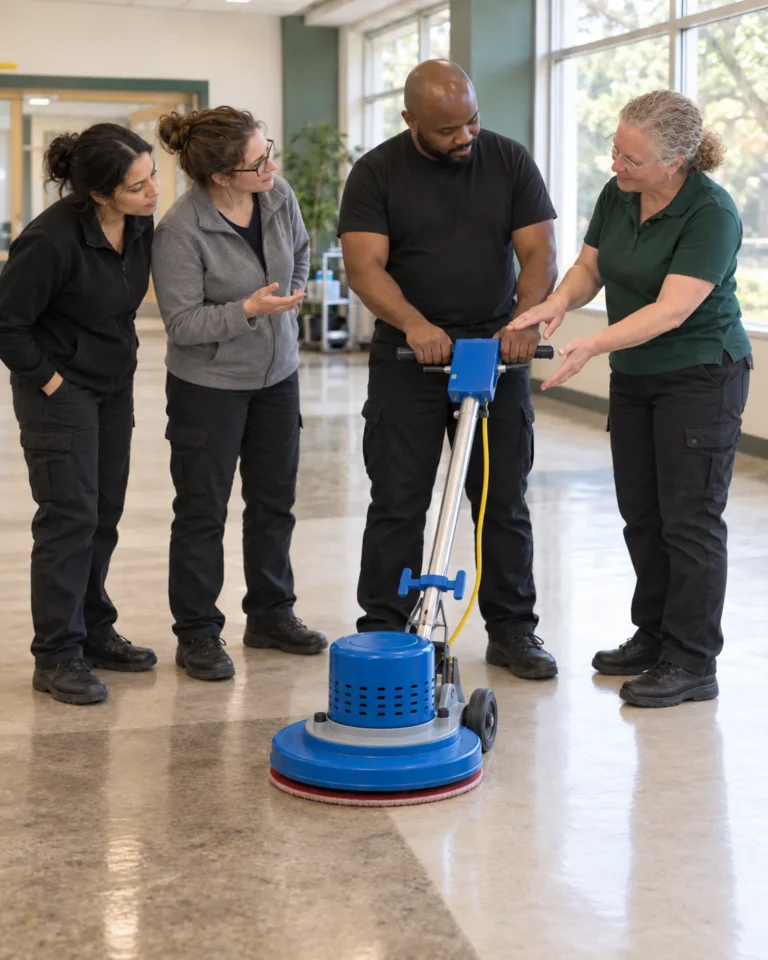
10. Confusing a burnisher with a floor buffer
They look similar and do different jobs. According to Tennant, most buffers run at about 175 RPM and are used for scrubbing and stripping, while burnishers spin at 1,500 to 2,500 RPM to produce a high gloss on a finished floor. Our floor-care equipment guide covers the differences.
11. Treating the symptom before finding the cause
A floor looks cloudy, so the worker reaches for a stronger cleaner. But is it finish haze from poor application, detergent residue, damage from the wrong pad, or wear in the flooring itself? Until the cause is known, aggressive cleaning can make diagnosis harder and the condition worse. Good cleaning starts with observation. Many of these cases are explained in why floor finish fails.
12. Teaching the task without teaching the reason
You can teach someone “this chemical, this bucket, this mop” and they will repeat it perfectly, until the floor, the product or the equipment changes. A person who has memorized a procedure knows what to do when conditions stay the same. A person who understands why it works can tell when conditions have changed.
That is the difference Servitech aims for in every course. Instruction is led by Wendy Hansen, who has worked in the professional cleaning industry for more than 45 years, and it is built on practical understanding, not memorized steps.
How training prevents these mistakes
- Workers learn to identify surfaces and soils before choosing a product.
- Dilution, dwell time and chemical safety become habits with reasons behind them.
- Equipment, pads and procedures are matched to the floor.
- Supervisors get a shared standard to check work against.
Related training: BSW 1: Basic Commercial Cleaning, BSW 2: Hard Floor Care and BSW 3: Commercial Carpet Cleaning are Building Service Worker certificate programs delivered on-site for custodial and janitorial teams across British Columbia. Request training for your organization.
Frequently asked questions
What is the most common commercial cleaning mistake?
There is no single one, but most problems trace back to a mismatch between the surface, the product, the equipment and the procedure. Over-using chemical is probably the most frequent.
Can using too much cleaner make a floor look dirty?
Yes. Excess product leaves a residue that attracts soil and can make a floor look dull or feel sticky. Follow the dilution on the label.
Why should you never mix cleaning chemicals?
Cleaning products can react with each other. Bleach mixed with ammonia or other cleaners can release dangerous gases. Only mix products if the manufacturer instructs it.
Is professional cleaning skilled work?
Yes. Custodians and building service workers make decisions about chemistry, surfaces, equipment, contamination and safety every shift, and those decisions affect both results and workplace safety.
Why is a cleaning checklist not enough?
Checklists support consistency, but they cannot cover every condition. Understanding the principles behind the procedure lets a worker recognize and respond to something unexpected.
How do you train janitorial staff to avoid these mistakes?
Teach the reasons along with the steps: how to identify surfaces and soils, how to dilute and handle chemicals, and how to match equipment and pads to the floor. Hands-on, instructor-led training is the most reliable way to build those habits.